| The U. S. Custom House |
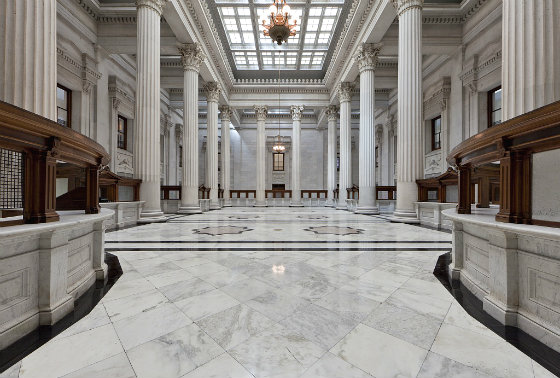
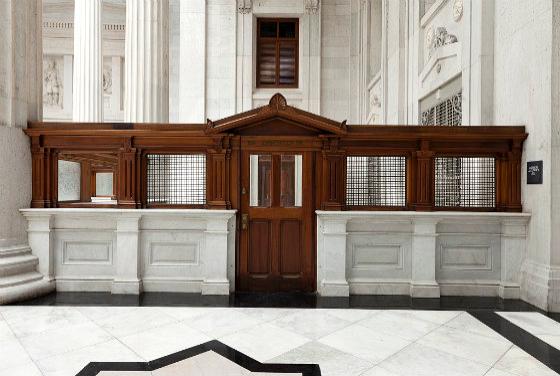
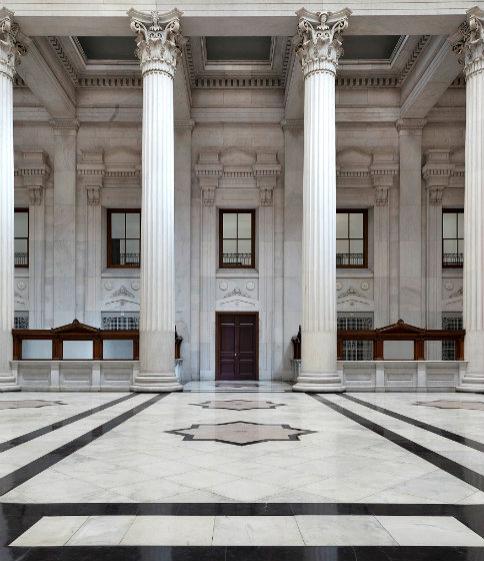
| The grand Marble Hall of the Custom House, considered one of the finest Greek Revival interiors in the U.S. |

| Photo Credits: Photo at the top of the page and bottom three: Carol.M.Highsmith@Library.of.Congress In descending order, photos six and seven: Infrogmation@WikimediaCommons Photo second from bottom: U.S. General Services Administration The link to this page is: http://old-new-orleans.com/NO_CustomHouse.html Back to Old New Orleans Whispers - Home |
The U.S. Custom House in New Orleans is one of the oldest and most important federal
buildings in the South, one of the major works of architecture commissioned by the federal
government in the nineteenth century. Construction began on the building in 1848.
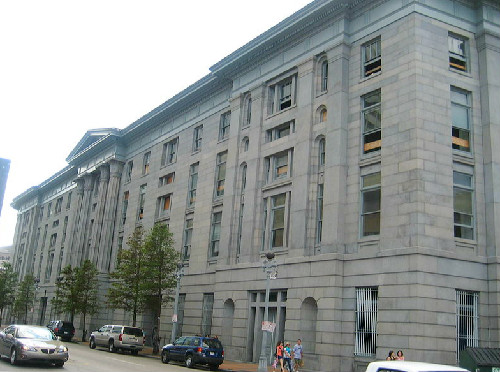
The Custom House is a huge building, occupying an entire downtown city block, bounded
by Canal, N. Peters, Iberville and Decatur Streets. It was intended to house U.S. Customs
offices, plus, the main post office, federal courts and other Federal offices.
The exterior of the Custom House looks the same as it did when construction was
completed. In 1916, the building underwent extensive interior renovations, following the
move of the post office and courts to a new facility on Lafayette Square. The interior
offices were subdivided and corridors reconfigured. However, after Hurricane Katrina
damaged the building in 2005, the GSA launched a major effort to restore the interior to its
original appearance, exposing such elements as the vaulted ceilings and replicating
elements such as the skylight over the stairs. These detailed restorations were completed
in the summer of 2011.
buildings in the South, one of the major works of architecture commissioned by the federal
government in the nineteenth century. Construction began on the building in 1848.
The Custom House is a huge building, occupying an entire downtown city block, bounded
by Canal, N. Peters, Iberville and Decatur Streets. It was intended to house U.S. Customs
offices, plus, the main post office, federal courts and other Federal offices.
The exterior of the Custom House looks the same as it did when construction was
completed. In 1916, the building underwent extensive interior renovations, following the
move of the post office and courts to a new facility on Lafayette Square. The interior
offices were subdivided and corridors reconfigured. However, after Hurricane Katrina
damaged the building in 2005, the GSA launched a major effort to restore the interior to its
original appearance, exposing such elements as the vaulted ceilings and replicating
elements such as the skylight over the stairs. These detailed restorations were completed
in the summer of 2011.
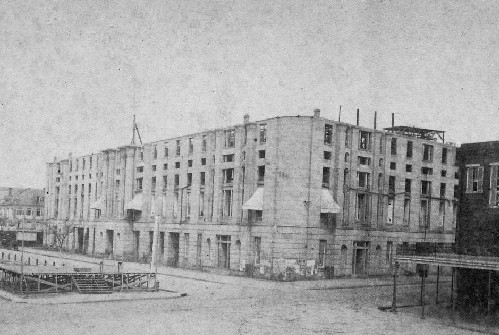
| Custom House, under construction, 1850's |
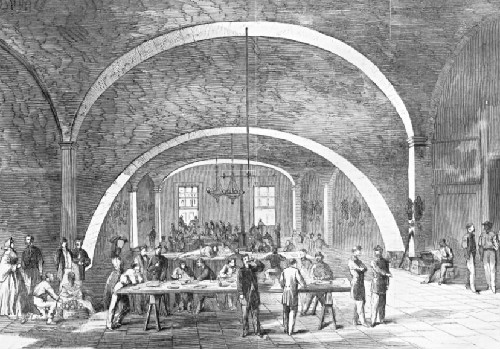
| Interior, a sketch from Harper's Weekly of Confederate prisoners housed in the Custom House during the Civil War. |
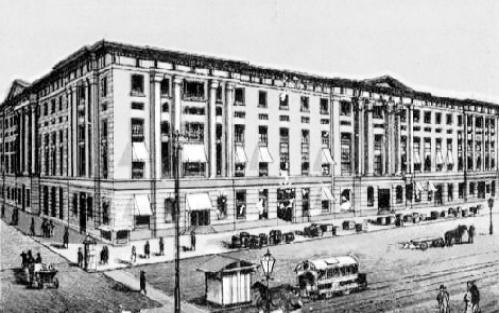
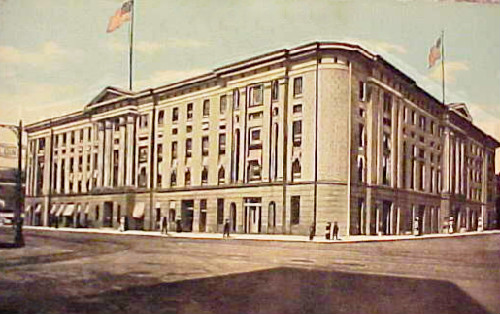
| Custom House, 1880's |
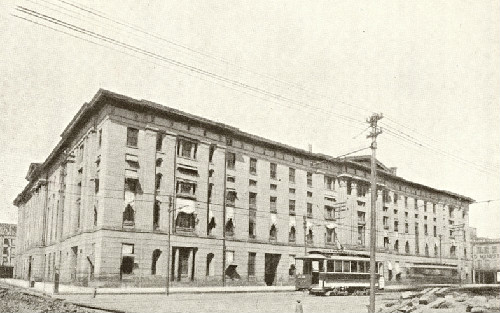
| Above & below, 1901 |
The floor plan of the Custom House is arranged around an impressive Greek Revival room
known as the Marble Hall, one of the first such rooms in the country. The room is ninety-five by
one hundred twenty-five feet, by fifty-four feet in height. It is ornamented with Corinthian
columns that depict the heads of the mythological god Mercury, guardian of boundaries,
commerce and roads, and the goddess Luna, whose crescent moon-shaped brow symbolizes
the city's location at the crescent bend of the Mississippi River. A cove above the cornice
supports a sophisticated geometrically composed skylight. Over the entrance at the N. Peters
Street side of the hall are sculptures depicting the founder of New Orleans, Sieur de Bienville,
and Gen. Andrew Jackson.
A description from Stanley C. Arthur's "A History of the U.S. Custom House at New Orleans,"
written in 1940: "It was termed 'the finest business room in the world.' In point of area, height or
in interior decoration, the Marble Hall is not surpassed by any public building in the United.
States."
known as the Marble Hall, one of the first such rooms in the country. The room is ninety-five by
one hundred twenty-five feet, by fifty-four feet in height. It is ornamented with Corinthian
columns that depict the heads of the mythological god Mercury, guardian of boundaries,
commerce and roads, and the goddess Luna, whose crescent moon-shaped brow symbolizes
the city's location at the crescent bend of the Mississippi River. A cove above the cornice
supports a sophisticated geometrically composed skylight. Over the entrance at the N. Peters
Street side of the hall are sculptures depicting the founder of New Orleans, Sieur de Bienville,
and Gen. Andrew Jackson.
A description from Stanley C. Arthur's "A History of the U.S. Custom House at New Orleans,"
written in 1940: "It was termed 'the finest business room in the world.' In point of area, height or
in interior decoration, the Marble Hall is not surpassed by any public building in the United.
States."
| Above & below: Custom House as it looks today. For the past 3 years, the first floor of the Custom House has been occupied by the Audubon Insectarium, the largest museum devoted to insects in North America. The U.S. Customs and Border Protection offices are housed on the upper floors, having returned to the building in August, 2011, after extensive restoration following Hurricane Katrina. |